
By Anne Caldwell with contributions from Eve Moreton and Charles Philpott
On the 29th and 30th of October, the University of Leeds hosted an interactive exhibition and workshop entitled “Palestine Through Time”. We did so with the generous support of the Palestine Exploration Fund, and as a collaboration between artist Mado Kelleyan and the School of Performance and Cultural Industries, with support from two student researchers in the School of History.
The exhibition itself was comprised of four main sections: a section on the early history of the PEF, a section that utilised images taken by Kelleyan on her recent trip to Israel/Palestine, a station with a video of her narrating the research process, and the final section, which enabled participants to experience her VR programme, “Stories From My Grandmother’s House”. In the evening, participants were invited to listen to a panel from myself, my co-grant writer Dr Dani Abulhawa, and Mado Kelleyan. This blog post will primarily focus on the exhibition, the panel, and participant reactions to them.
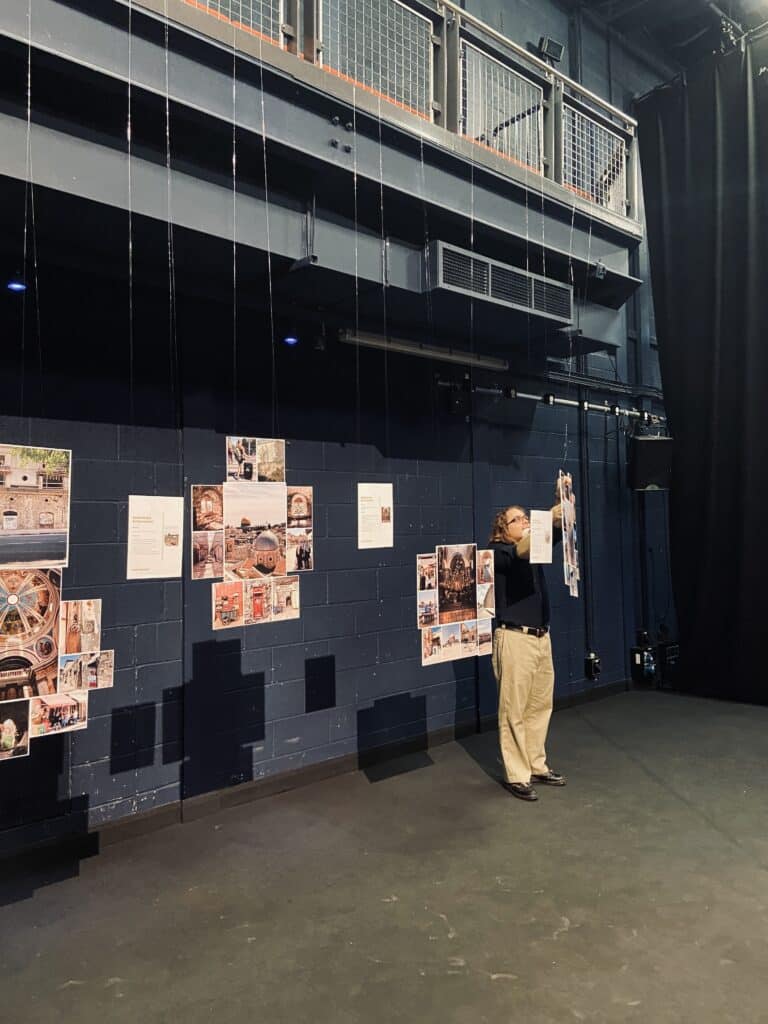
Charles Philpott adds finishing touches to the exhibition.
Edward Said remarked that “Seeing ‘the entire world as a foreign land’ makes possible originality of vision. Most people are principally aware of one culture, one setting, one home; exiles are aware of at least two”. In Mado Kelleyan’s work, we are made aware of three – her reality of growing up in Britain, removed from her Palestinian and Armenian roots.
Kelleyan has created a VR experience that centres on her grandmother’s house in 1930s Haifa – a pre-Nakba family story that takes you on a journey many only have the opportunity to experience through oral traditions. You are transported from the living room to a shipwreck off the coast of Akka in the 1700s to the lost histories of her Armenian family in the midst of genocide in the 1910s to her grandparents meeting by chance in Haifa and a fourth scene which tells the after. In this way, her work speaks to the complexity of identity that resonates with so many when it comes to a sense of historical and contemporary belonging.
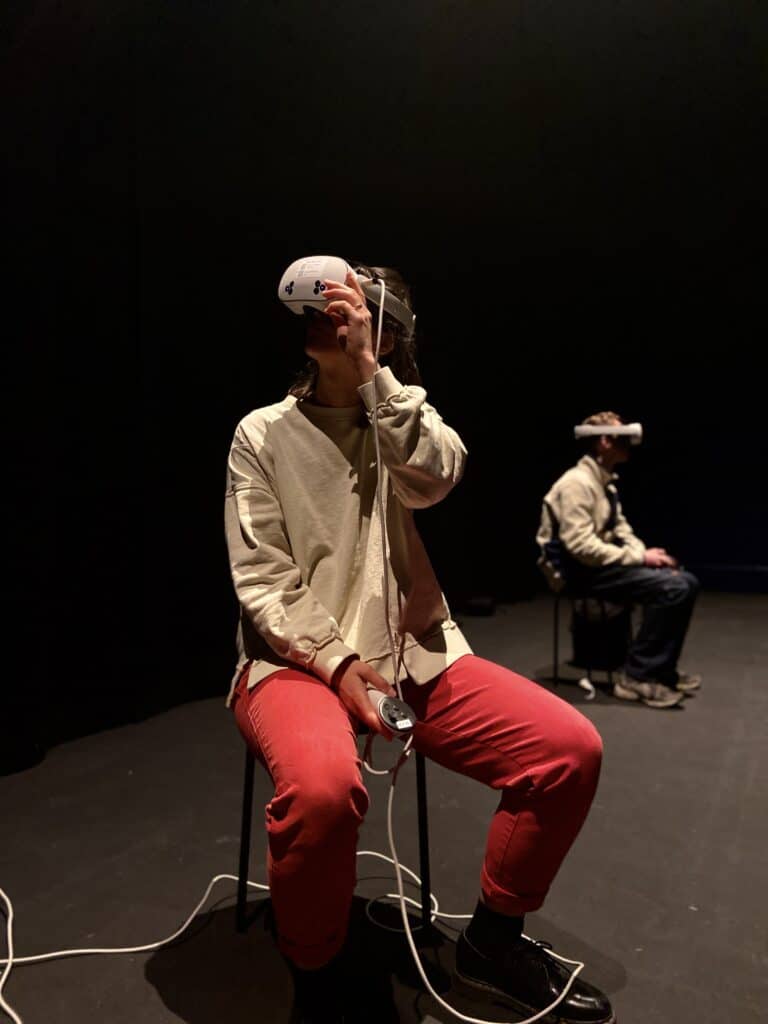
Mado Kelleyan’s VR experience.
Indeed, this complexity made the experience feel urgent. In academia, we are often focused on institutional knowledge; priority is given to those histories that are legitimised through the academic process, sanitized by the historian’s pen. We have ethics forms, and paywalls, and archives which give us access to histories that often belong to others. What made this work different was the power it offered to a personal narrative. It took back the power from the archives, allowing the viewer the chance to engage with stories carried in the hearts and minds of the families who experienced them. As Kelleyan wrote for one of our captions:
In a space of contested histories, the project considers sensory storytelling and oral histories as a non-academic form of knowledge – asking the audience how they can come to understand a history not through facts, figures and academic study, but rather how we can know through feeling, and whether virtual reality can offer us spatial memories of our heritage in order to carry it forward, as living memory, into the future.
In order to elevate this element, my student researchers, Charles Philpott and Eve Moreton, wanted to focus the opening section on the way in which colonialism played in the research conducted by the PEF, how it still impacts our perceptions of Palestine today, and, as Charles put it, to “question what equipment we are using to conduct our research”. This final element is key when we consider which histories are available and which histories we listen to. Who has access to the archives? Or as Eve asked: “Why is it that all these useful and informative articles I have been reading over the course of three years are only accessible to me as a student? Why is it that these academics are, for the most part, only in conversation with each other rather than the public?”
Kelleyan and the student researchers engaged with questions that we should all be asking – how is what we are learning, what we are researching, dictated by the power structures that place academic knowledge above lived experiences or inherited histories? And in many ways, in much of the work that it is does, and by funding projects like this one, that is what the PEF asks, as well. Many institutions like the PEF, founded at the height of colonial exploration, or based on colonial understandings of the world, are attempting to meet the current moment. While decolonization may not be possible, they they actively push to bring in researchers like Kelleyan who may otherwise not have knowledge of their archives or that they are open to those who sit outside of academia. Access is not simply about who is allowed into a space, or feels welcome in a space, but who knows about the space, who has resources and time to participate in a space, or even who is able to simply reach the space. Funding like this also allows academics, students and the public, who sit outside of the field, or the geographic location of London, an opportunity to engage with archives that might otherwise be beyond their resource-based reach. Experiencing the archive through the work of a non-academic or students, also reminds people that these archives are there for them too, and is vital to breaking down the sense of gate-keeping many believe exists within academic spaces.
While the intricate detail of the VR experience was certainly informed by the archives, Kelleyan also utilized what she referred to as “’digital entering’ – using platforms and technologies such as Airbnb and Google Street view to gain access to different locations”. As technology advances, so to does our potential for access to it. Indeed, it was technology that allowed her to find her family, and recover and recreate lost stories.
For our participants, this exhibition opened them to a personal history that they are not often exposed to. They responded overwhelmingly positive to “how this sort of research might serve to increase the impact of history”, and as another participant put it, that it wasn’t “focalised through the perspective of Western occupation.” Rather than create an exhibition that spanned the entirety of Palestinian history, for participants, the focus on “[family history within the] VR experience humanises Palestinians and those living in Israel/Palestine.” Own story history has the power to reshape our understanding of the past and the present. Further, it enables students of history, and everyday individuals to empathise with the stories being told. Kelleyan’s work spoke to those who are often erased in our everyday narratives; “anyone who has questioned their cultural, ethnic and national identity, particularly as a result of displacement would be able to relate to what she was saying and presented in the VR and through the panel.” Indeed, in one particularly powerful moment, the Deputy Director of the Centre for Jewish Studies emerged from his VR experience with tears in his eyes, full of vigour that we must do more create spaces like this one – to share personal stories of survival, of love, and of resilience. While history is political, it is also humanising. It allows us to cross borders, to empathise with the dead and the living.
The opportunity it offered two students should also not be overlooked. While Kelleyan’s work should be centred, as academics we should remember that our work is part of a wider conversation. Our jobs are not just to teach others about the world, but to actively listen to other experiences and perspectives. This includes the perspectives of our students. Participants were blown away by the work that our student researchers did. Of particular note, were the students’ reflections, most especially Eve’s. It became clear that her struggle to find meaning in her studies up to this point resonated with many. To me, this speaks to a larger struggle in academia and the heritage sector, for our work to have meaning beyond the institution. Projects like this one, funded by the PEF, will hopefully continue to enable us to do just that.
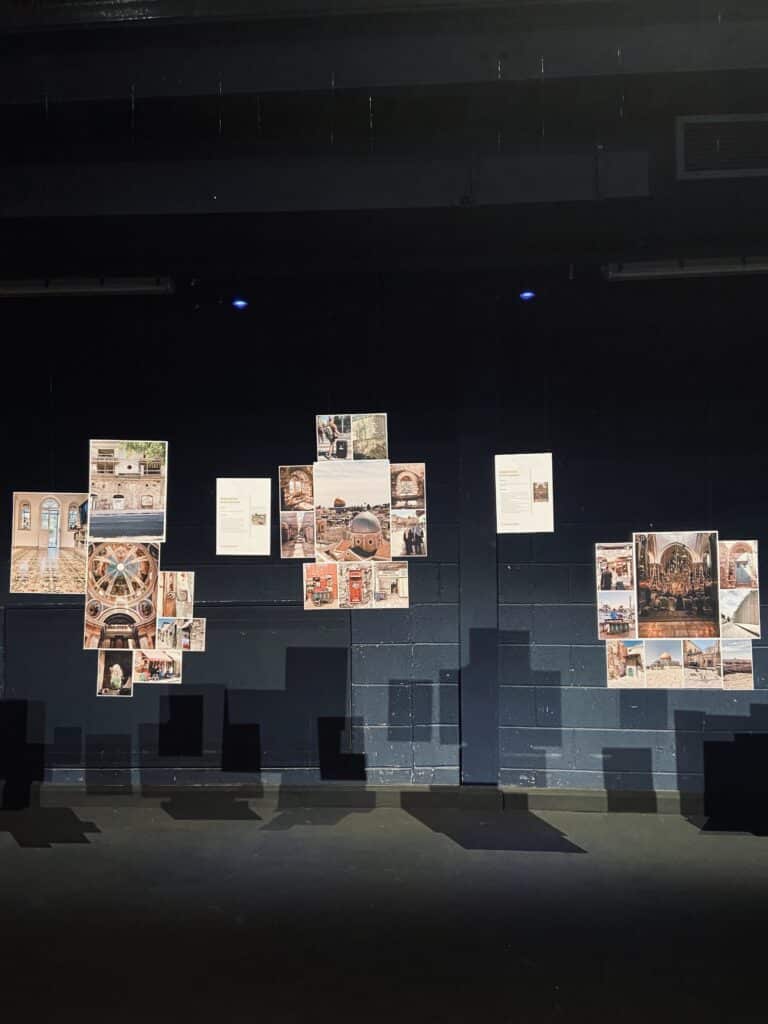
The finished exhibition.
Below I have included excerpts from the students’ reflections, to allow them to speak to their own experiences of this project:
Eve Moreton’s Reflections Excerpt
“This exhibition, and the research trips to the PEF, reignited my passion for History. I think for many students, our love for a subject can often feel leeched out of us by regimented essays and forced readings, which can feel tedious. However, this project, gave me a new understanding of how my degree can be used to make history accessible.
If it hadn’t been for the optional module [on Israel/Palestine] in my second year, I would know little about Palestine besides what gets shown on the news. This was a startling realisation for me. Increasingly I found myself disillusioned with my undergraduate degree and the prospects of academic research. Why is it that all these useful and informative articles I have been reading over the course of three years are only accessible to me as a student? Why is it that these academics are, for the most part, only in conversation with each other rather than the public? Museums and exhibitions, like this one, are such vital points of contact with the historical for communities. Before my visit to the PEF, I had never even heard of the Fund, and yet only a few short months later I have been given the chance to bring that knowledge and history to others.
Despite having never done anything like this before, you are reading this, whilst stood in a fully finished and materialised exhibition space. That’s an achievement. It’s an achievement that I hope to be able to bring forward to my career and use as a stepping stone for making history accessible to everyone.”
Charles Philpott’s Reflection Excerpt
“It was there [at the PEF], staring in awe at the metal-cast relief map of the Survey of Western Palestine, that I understood where I wanted this project to go. The visceral geographic scars of wadis that spanned many kilometres of rugged landscape, borne in metal, and flowing towards the arterial River Jordan, sparked my fascination with water in the region. Having written a policy briefing for an assignment about the disparity in water security between Palestine and Israel last year, I was driven to understand how the land once was…
Historians often talk about ‘historiography’ as if everyone understands the principle. To define the study of an entire era, from the dawn of civilisation to yesterday’s BBC headlines, into a single term seems to render out the beautifully intricate detail. Yet I think this exhibition’s place in the historiography is as clear as it is important. Palestine is the subject of countless news articles, opinion pieces, debates, journal articles and political discussions, but very rarely do we ever step back, away from the magnifying glass and question what equipment we are using to conduct our research…
… A new set of spectacles is being placed on the face of historiography, and we need to understand how this will shift our perspectives. In taking this step back, I hope you see how the fundamental media through which we experience Palestine today is as different as watercolours and glass-plate photography in the past, as virtual reality will be in the near future… That is what this exhibition truly represents: a marker, a waypoint flag in the time-technology nexus, and an opportunity to evaluate the question of ‘when does history become the present?’. Now more than ever, we as individuals can contribute to this elusive and frustratingly complex term of ‘historiography’. Everyone’s existence is contributing day by day to the history of the next generation, and every time you perceive Palestine, treat it with the same reverence.”
